
THE RADICALISATION PROCESS
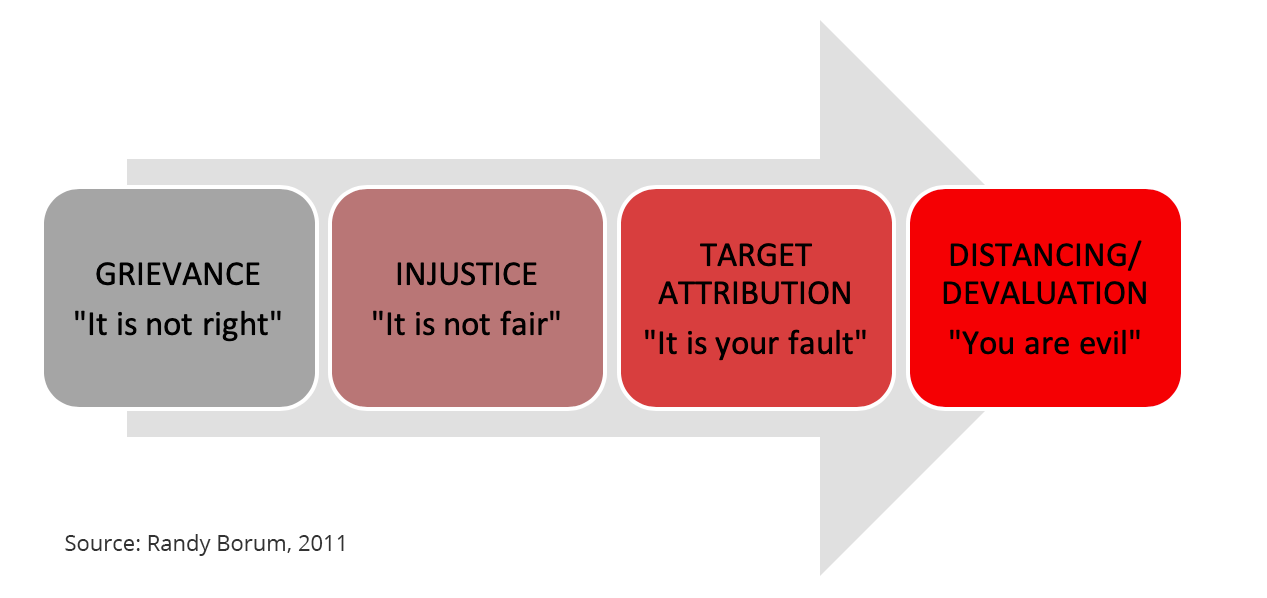
During the last 20 years, researchers and practitioners developed a great variety of models to explain the process of radicalization. Among the best-known models are those developed by Randy Borum and Fathali M. Moghaddam (Borum, R., 2011): “Radicalization into violent extremism II”. Journal of Strategic Security no. 4 ).
Randy Borum aims to combine the common factors in processes of radicalization in a four-stage model.
The model illustrates how the experience of grievances, discrimination and vulnerabilities gradually transform into being caused by external factors, be it persons, groups or society in general. Step by step, the young people direct their aggression at some enemy: ”target attribution: it´s your fault “. The last stage involves hatred and demonization and/or dehumanization of the responsible party, and at this stage some individuals may commit violent acts.
Likewise, Fathali M. Moghaddam´s model is called the “staircase to terrorism“.

In the staircase model, the process of radicalization initiates with experiences of grievances and injustice. Thus, the ground floor of the model may include a lot of individuals. Many young people would agree to the experience of injustice, and they may often sympathize with and even support, those who choose to act and do something about it.
An increasingly small number of individuals proceed to the higher floors of the staircase model. However, only a very few individuals climb to the final floor, where they “sidestep inhibitory mechanisms“ and commit violent acts.
Other models introduce more intermediate steps. However, despite the variations, this type of procedural models generally raises similar, important questions such as:
- Which factors trigger the radicalization process?
- Why do individuals with the same characteristics not become radicalized?
- When and why do some individuals take the last step into violent extremism?
- Is it possible to interrupt the process and perhaps get re-involved on the same or another step later on?
- Which factors and mechanisms are determinative for individuals to stop the process?
- When and why do individuals progress from one phase to the next?